
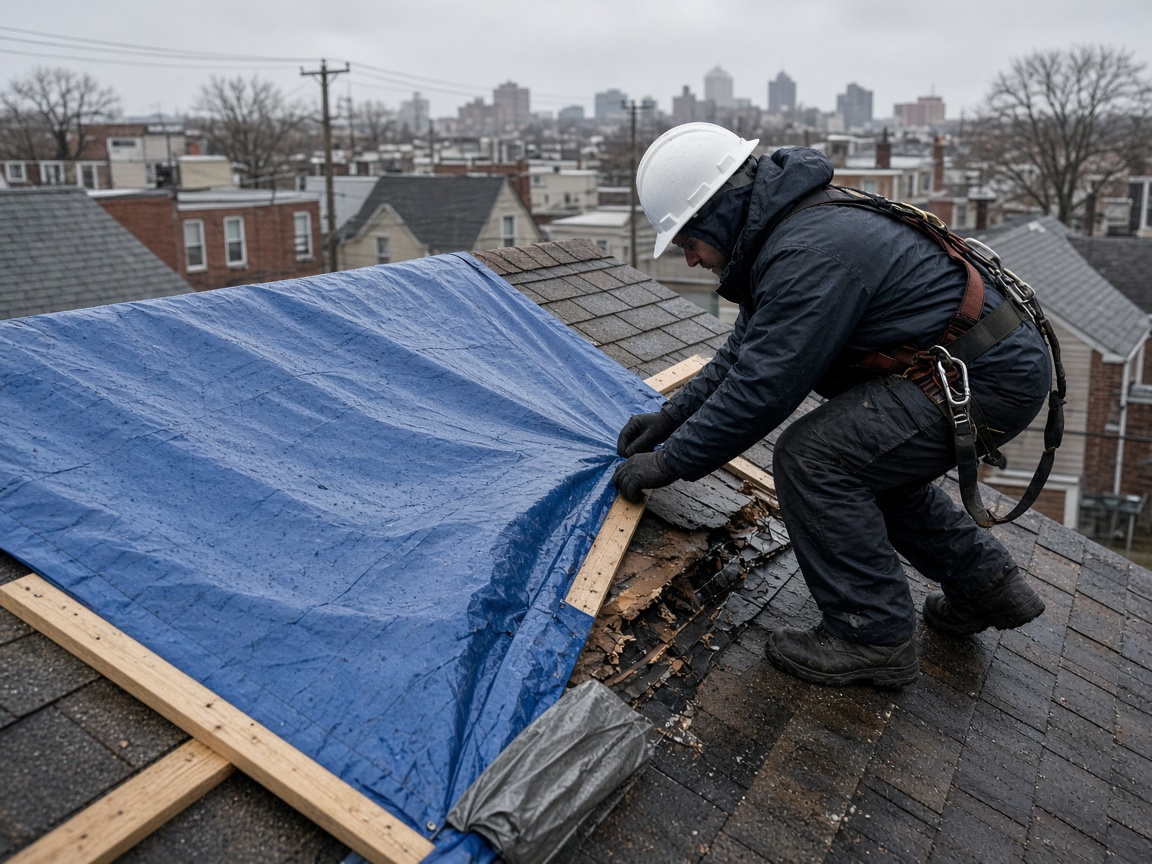
Newark’s humid subtropical climate brings sudden summer thunderstorms and winter nor’easters that tear shingles or split flashing on older row homes common in the Ironbound and Vailsburg. Emergency tarping uses 6-mil reinforced polyethylene anchored with furring strips and masonry screws to create a watertight seal over damaged sections until permanent repairs can be scheduled. Crews must account for the steep pitches on Central Ward Victorians and the low-slope modified bitumen roofs found near Newark Penn Station and the Prudential Center where wind uplift from Newark Liberty International Airport traffic is stronger.
Edge cases include tarps that shift on Weequahic’s tree-lined streets when heavy snow loads arrive or when crews work around active Amtrak lines running through University Heights. Proper overlap of at least 4 feet and perimeter sealing with butyl tape prevents water from migrating under the tarp during the freeze-thaw cycles typical in Essex County. Homeowners in North Ward and South Ward often discover that skipping tarping after a small leak leads to ceiling damage in the finished attics common in pre-1940 housing stock.
Local code in Newark requires any temporary covering visible from the street to be removed within 30 days unless a permit extension is filed, so tarping crews document the install with photos and provide the homeowner the contact for follow-up repair permits. Materials are chosen to withstand the high UV exposure on south-facing roofs during July and August without degrading before permanent work begins.
Technician insight
In Newark the thing that catches most people out with Emergency Tarping is underestimating wind loads on the flat roofs common in the Ironbound near the airport; a standard tarp will lift in the first nor’easter if you don’t add extra furring every 16 inches and switch to masonry anchors on the brick parapets.
Vailsburg Two-Story After July Storm
A sudden thunderstorm tore flashing on a 1920s two-story in Vailsburg. Water was already staining the second-floor ceiling when the call came in. We staged a reinforced tarp the same afternoon, anchored it to the existing decking and parapet with extra furring strips, and sealed every seam. No further interior damage occurred before the permanent repair two weeks later.
Emergency Tarping Services We Offer
✓Storm Damage Tarping
Immediate coverage after wind or hail events to protect interiors in neighborhoods like Downtown Newark and Ironbound until full assessment.
✓Leak Prevention Tarping
Targeted tarping over active leaks on flat and low-slope roofs common near Branch Brook Park and the New Jersey Performing Arts Center.
✓Commercial Roof Tarping
Larger-scale temporary membranes for retail and office buildings around Newark Penn Station and Prudential Center where downtime must stay minimal.
✓Winter Emergency Tarping
Reinforced installs that handle snow and ice loads on North Ward and Weequahic homes before temperatures drop below freezing.
✓Airport Corridor Tarping
High-wind rated tarping for properties near Newark Liberty International Airport where gusts regularly exceed standard residential installs.
Emergency Tarping Cost in Newark, NJ
| Service | Typical Range | What Affects It |
|---|---|---|
| Small residential section (under 200 sq ft) | $250–$450 | Single-story homes in Vailsburg or South Ward with easy ladder access |
| Standard residential tarp (200–400 sq ft) | $450–$750 | Two-story Ironbound or North Ward row homes; steeper pitches add labor |
| Large or commercial section | $900–$1800 | Low-slope roofs near Prudential Center or Newark Penn Station; requires more anchors |
| After-hours or weekend response | Add $150–$300 | Calls outside Mon–Fri 8–6 or Sat 9–2 |
Ranges are typical for Newark, NJ and confirmed with an exact written quote before any work starts.
How it works
- 1
Initial Assessment
Technician inspects from the ground and safe roof access points to map damaged sections and note nearby power lines or tree hazards typical in Newark blocks.
- 2
Material Staging
Reinforced tarp, fasteners, and sealant are measured on-site and cut to allow 4-foot overlaps required for Essex County wind exposure.
- 3
Secure Installation
Tarp is positioned, anchored with furring strips and appropriate masonry or deck screws, then perimeter sealed to block driving rain.
- 4
Documentation And Handover
Photos are taken for insurance and the homeowner receives removal timeline guidance tied to Newark permit rules.
Pricing
Most Newark emergency tarps fall between a few hundred dollars for small residential sections and low thousands for larger commercial roofs; final cost depends on access, pitch, and square footage.